Statistically compares partial Area Under the Curve (pAUC) values between two lineup conditions using bootstrap-based standard errors and z-tests. Follows the methodology from pyWitness (Mickes et al., 2024).
Usage
compare_pauc(
  data1,
  data2,
  lineup_size = 6,
  max_false_id_rate = NULL,
  n_bootstrap = 2000,
  conf_level = 0.95,
  seed = NULL,
  label1 = "Condition 1",
  label2 = "Condition 2",
  innocent_suspect = "auto"
)
Arguments
- data1
First dataset (dataframe with target_present, identification, confidence)
- data2
Second dataset (same format as data1)
- lineup_size
Integer. Number of people in lineup (default = 6)
- max_false_id_rate
Numeric. Upper limit of the false-ID rate region over which partial AUC is computed. Default
NULLuses the largest region both conditions actually reach, i.e. the smaller of their two maximum observed false-ID rates. Supplying a larger value means at least one condition is integrated only as far as its own data extend, so the two areas cover different intervals; a warning is issued in that case.- n_bootstrap
Integer. Number of bootstrap samples (default = 2000)
- conf_level
Numeric. Confidence level for intervals (default = 0.95)
- seed
Integer. Random seed for reproducibility (default = NULL)
- label1
Character. Label for first condition (default = "Condition 1")
- label2
Character. Label for second condition (default = "Condition 2")
- innocent_suspect
How innocent-suspect identifications in target-absent lineups are obtained.
"designated": the lineups had a designated innocent suspect, so target-absent"suspect"rows are counted directly, and zero such rows means a false-ID rate of zero."estimated": there was no designated innocent suspect, so the innocent-suspect count is estimated as filler IDs divided bylineup_size."auto"(the default) chooses"designated"when any target-absent row is a suspect ID or the data have a non-missingsuspect_poscolumn, and"estimated"otherwise, with a message.
Value
An object of class "pauc_comparison" containing:
pauc1: pAUC for condition 1
pauc2: pAUC for condition 2
pauc_diff: Difference in pAUC (pauc1 - pauc2)
se_pauc1: Bootstrap standard error for pAUC1
se_pauc2: Bootstrap standard error for pAUC2
se_diff: Standard error of the difference
z_score: Z-statistic for difference test
p_value: Two-tailed p-value
ci_diff: Confidence interval for difference
roc1: ROC object for condition 1
roc2: ROC object for condition 2
max_false_id_rate: Cutoff used for pAUC
label1, label2: Condition labels
n_bootstrap: Number of bootstrap samples used
Details
This function implements an approximate statistical test for comparing ROC curves between two conditions (e.g., simultaneous vs. sequential lineups, different retention intervals, etc.).
**Method:**
Computes pAUC for each condition (optionally up to a maximum false ID rate)
Uses bootstrap resampling to estimate standard errors
Computes Z-statistic: Z = (pAUC1 - pAUC2) / SE(pAUC1 - pAUC2)
Calculates p-value from standard normal distribution
The two datasets are treated as independent conditions. This function does not implement a paired or clustered bootstrap.
**Interpretation:**
Positive pAUC difference: Condition 1 has better discriminability
Negative pAUC difference: Condition 2 has better discriminability
p < 0.05: Significant difference between conditions
The independent-sample bootstrap estimates uncertainty in an empirical partial-area functional; the final comparison uses a normal/Wald interval. It is approximate and can be liberal in finite samples. A data-selected cutoff, sparse high-confidence cells, or resamples that do not reach the cutoff require additional caution. It is not an exact discrimination test.
References
Mickes, L., Seale-Carlisle, T. M., Chen, X., & Boogert, S. (2024). pyWitness 1.0: A python eyewitness identification analysis toolkit. Behavior Research Methods, 56, 1533-1550.
Wixted, J. T., & Mickes, L. (2012). The field of eyewitness memory should abandon probative value and embrace receiver operating characteristic analysis. Perspectives on Psychological Science, 7(3), 275-278.
Examples
# \donttest{
# Compare two lineup procedures (halves of the example data)
data(lineup_example)
odd <- seq(1, nrow(lineup_example), by = 2)
comparison <- compare_pauc(
lineup_example[odd, ],
lineup_example[-odd, ],
label1 = "Procedure A",
label2 = "Procedure B",
n_bootstrap = 200,
seed = 123
)
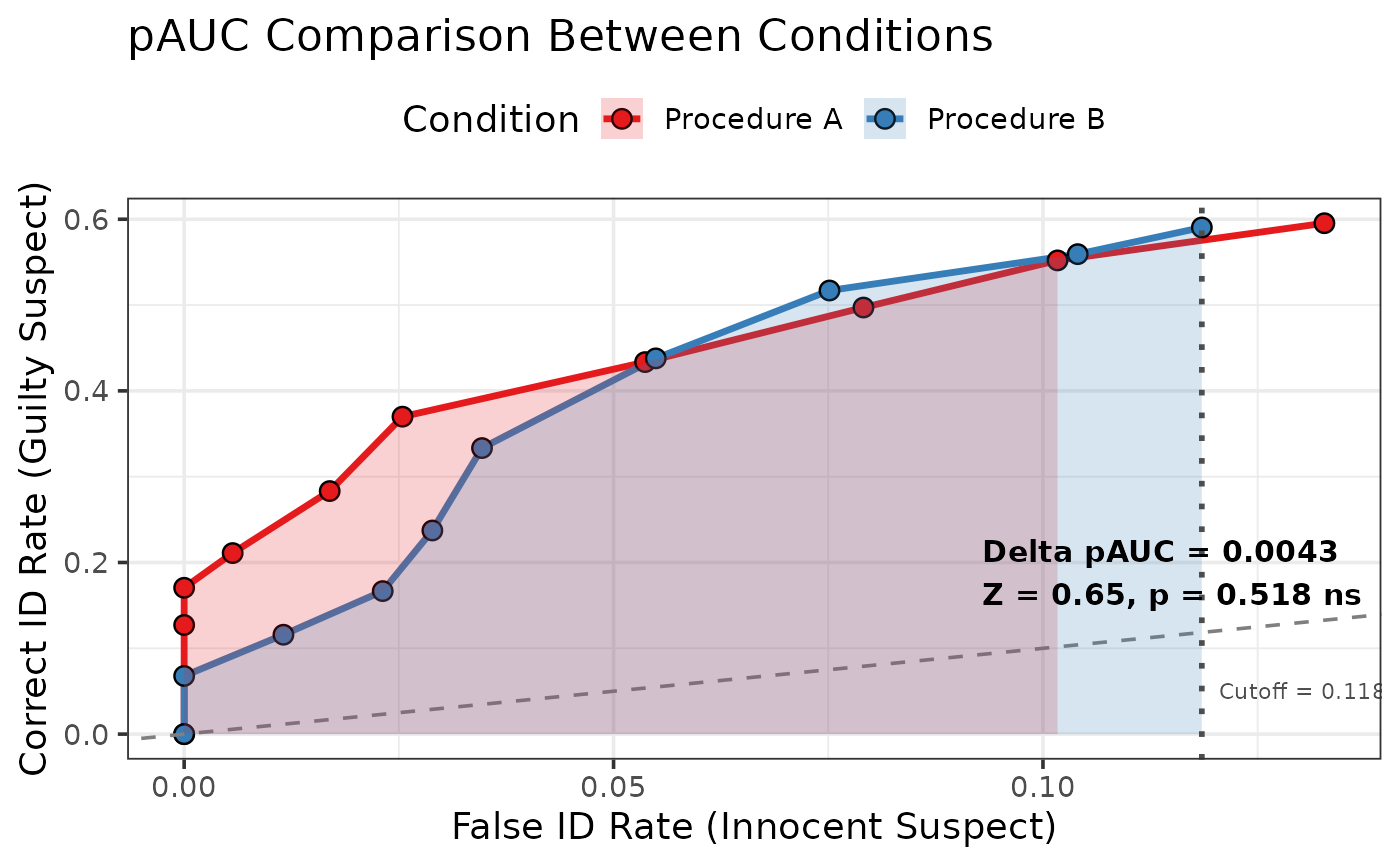
#> The two conditions reach different maximum false-ID rates (0.1328 and 0.1185). Partial AUC is computed over the largest region both attain, up to 0.1185. Set max_false_id_rate explicitly to override.
#> Computing bootstrap standard errors (200 samples)...
#> Done!
print(comparison)
#>
#> === pAUC Comparison Analysis ===
#>
#> Conditions:
#> Procedure A: pAUC = 0.0511 (SE = 0.0044)
#> Procedure B: pAUC = 0.0468 (SE = 0.005)
#>
#> Difference: 0.0043
#> 95% CI: [-0.0088, 0.0174]
#>
#> Statistical Test:
#> Z = 0.646
#> p-value = 0.5185
#>
#> Interpretation: Procedure A has higher discriminability than Procedure B (ns)
#>
#> Max false ID rate cutoff: 0.1185
#> Bootstrap samples: 200
#>
#> Note: *** p<0.001, ** p<0.01, * p<0.05, ns = not significant
plot(comparison)
 # }