Generate example lineup identification data in standardized format. Useful for testing, demonstrations, and learning r4lineups functions.
Usage
create_example_lineup_data(
  n_trials = 100,
  prop_target_present = 0.5,
  include_confidence = TRUE,
  include_response_time = FALSE,
  seed = NULL
)
Arguments
- n_trials
Integer. Number of trials to generate (default = 100)
- prop_target_present
Numeric. Proportion of target-present lineups (default = 0.5)
- include_confidence
Logical. Include confidence ratings (default = TRUE)
- include_response_time
Logical. Include response times (default = FALSE)
- seed
Integer. Random seed for reproducibility (default = NULL)
Examples
# Basic example data
example_data <- create_example_lineup_data(n_trials = 200, seed = 123)
print(example_data)
#>
#> === Standardized Lineup Data ===
#>
#> Format: r4lineups standard format
#> Rows: 200
#> Columns: participant_id, target_present, identification, confidence
#>
#> Target-present trials: 97
#> Target-absent trials: 103
#>
#> Identifications:
#>   filler    : 62
#>   reject    : 64
#>   suspect   : 74
#>
#> Confidence range: 1 to 5
#>
#> First 10 rows:
#>    participant_id target_present identification confidence
#> 1               1          FALSE         reject          4
#> 2               2           TRUE         reject          1
#> 3               3          FALSE         filler          3
#> 4               4           TRUE        suspect          4
#> 5               5           TRUE        suspect          5
#> 6               6          FALSE         filler          5
#> 7               7           TRUE        suspect          4
#> 8               8           TRUE        suspect          5
#> 9               9           TRUE        suspect          5
#> 10             10          FALSE         reject          1

# Use in analysis
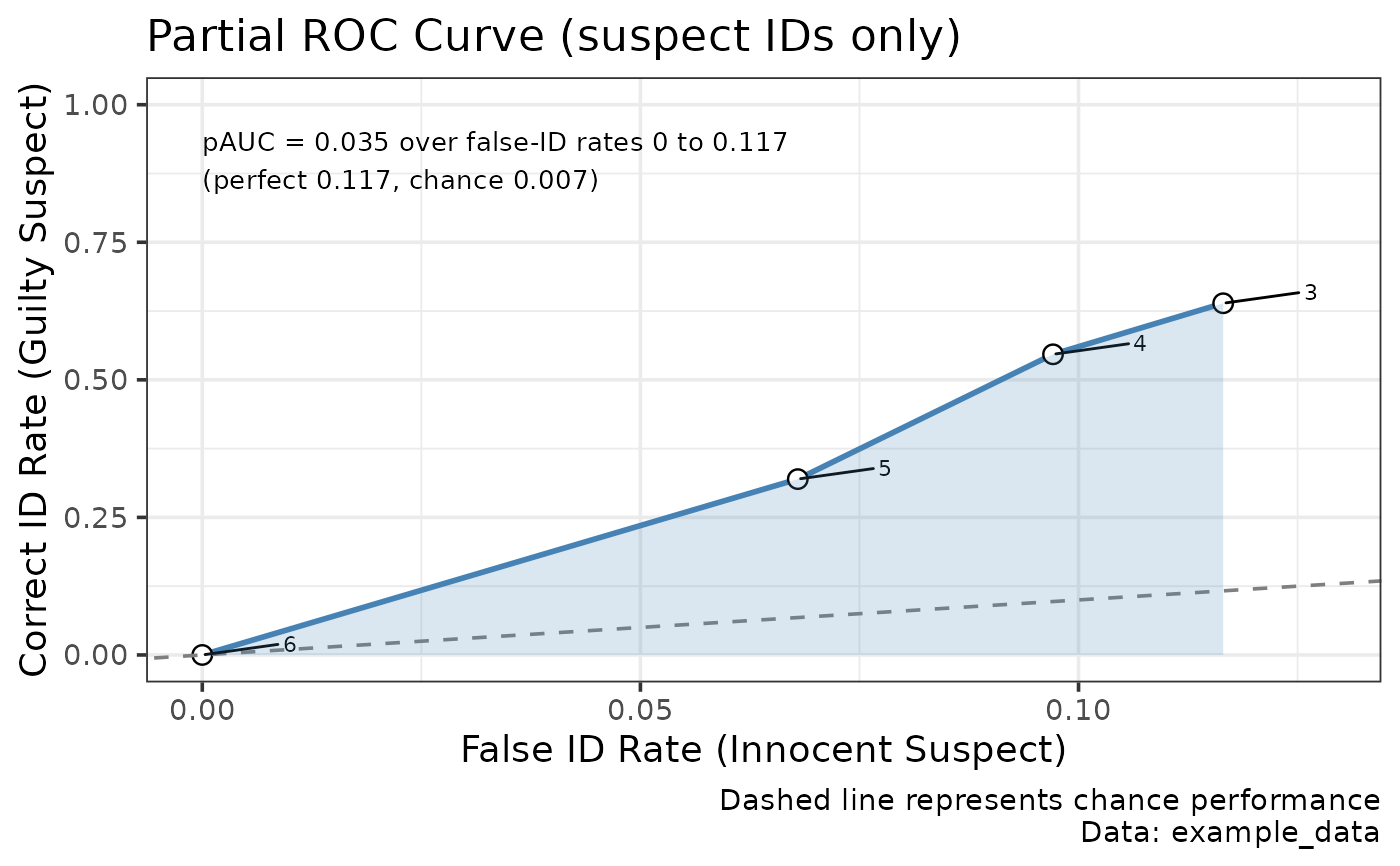
roc <- make_roc(example_data, lineup_size = 6)