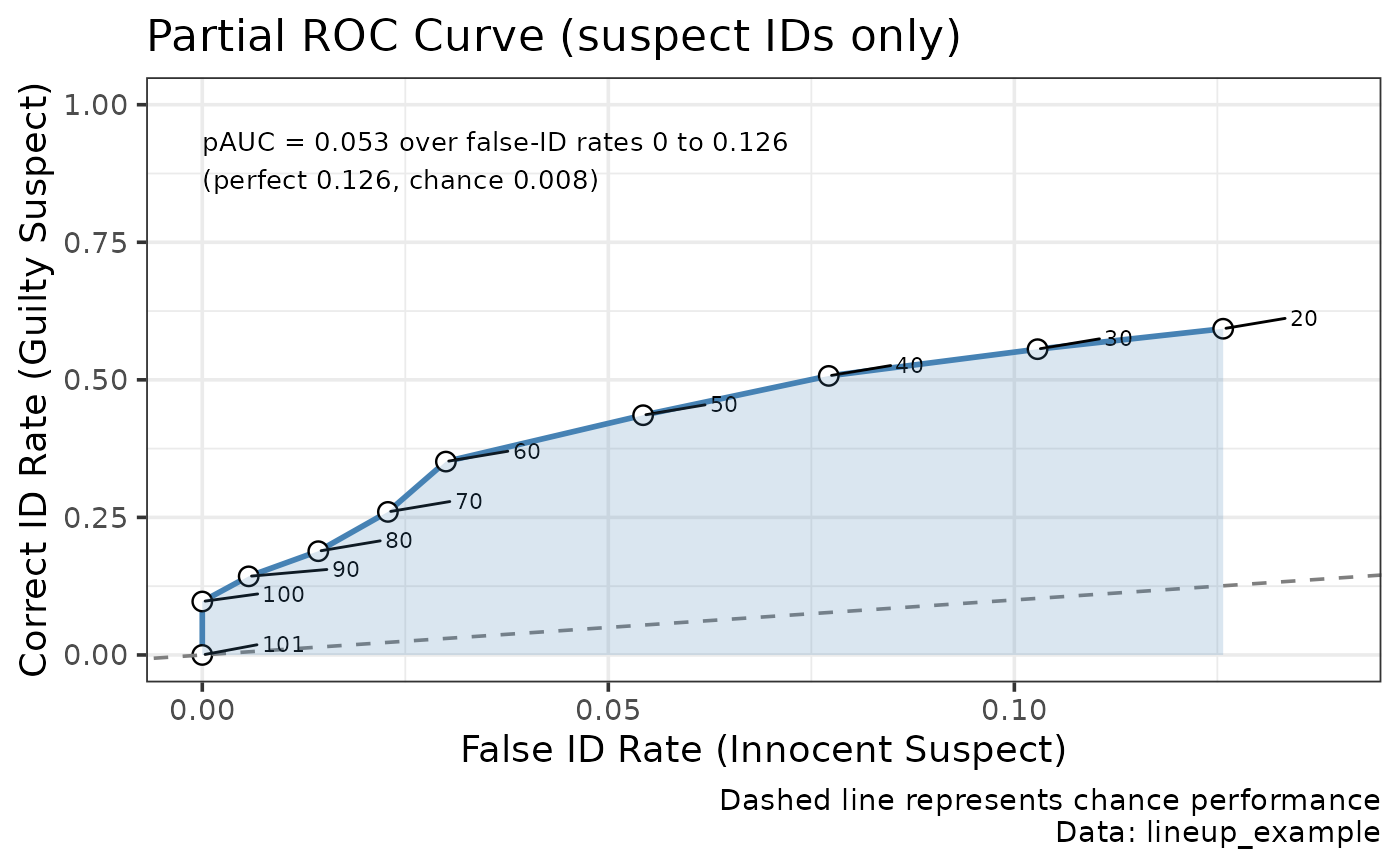
Main function to compute and plot an ROC curve for eyewitness lineup data. This follows the methodology of Wixted & Mickes (2012) and Mickes (2015).
Arguments
- data
A dataframe with the following columns:
target_present: Logical. TRUE if guilty suspect in lineup
identification: Character. "suspect", "filler", or "reject"
confidence: Numeric. Confidence rating
- lineup_size
Integer. Number of people in lineup (default = 6)
- show_plot
Logical. Whether to display the plot (default = TRUE)
- innocent_suspect
How innocent-suspect identifications in target-absent lineups are obtained.
"designated": the lineups had a designated innocent suspect, so target-absent"suspect"rows are counted directly, and zero such rows means a false-ID rate of zero."estimated": there was no designated innocent suspect, so the innocent-suspect count is estimated as filler IDs divided bylineup_size."auto"(the default) chooses"designated"when any target-absent row is a suspect ID or the data have a non-missingsuspect_poscolumn, and"estimated"otherwise, with a message.- ...
Additional arguments passed to make_roc_gg()
Value
A list containing:
plot: ggplot2 object. Always returned, whatever show_plot is set to; show_plot controls only whether it is displayed immediately
roc_data: Dataframe with ROC curve points
pauc: Partial area under the curve
summary: Summary statistics
Details
ROC analysis measures discriminability - the ability to distinguish innocent from guilty suspects. According to Mickes (2015), ROC analysis is most relevant for policymakers deciding on system variables (e.g., simultaneous vs. sequential lineups, lineup size, etc.).
For estimator variables (e.g., exposure duration, retention interval), use
CAC analysis instead (see make_cac).
References
Wixted, J. T., & Mickes, L. (2012). The field of eyewitness memory should abandon probative value and embrace receiver operating characteristic analysis. Perspectives on Psychological Science, 7(3), 275-278.
Mickes, L. (2015). Receiver operating characteristic analysis and confidence-accuracy characteristic analysis in investigations of system variables and estimator variables that affect eyewitness memory. Journal of Applied Research in Memory and Cognition, 4(2), 93-102.